Led product design and brand identity for Tracer in Q1/Q2 2023, creating a component monitoring system for government compliance (cATO: Continuous Authority To Operate). Created an interface experience that made complex compliance relationships navigable, directly contributing to $1.1M SBIR grant. Designed role-based workflows transforming 12-18 month, $2M manual processes into streamlined digital experiences.
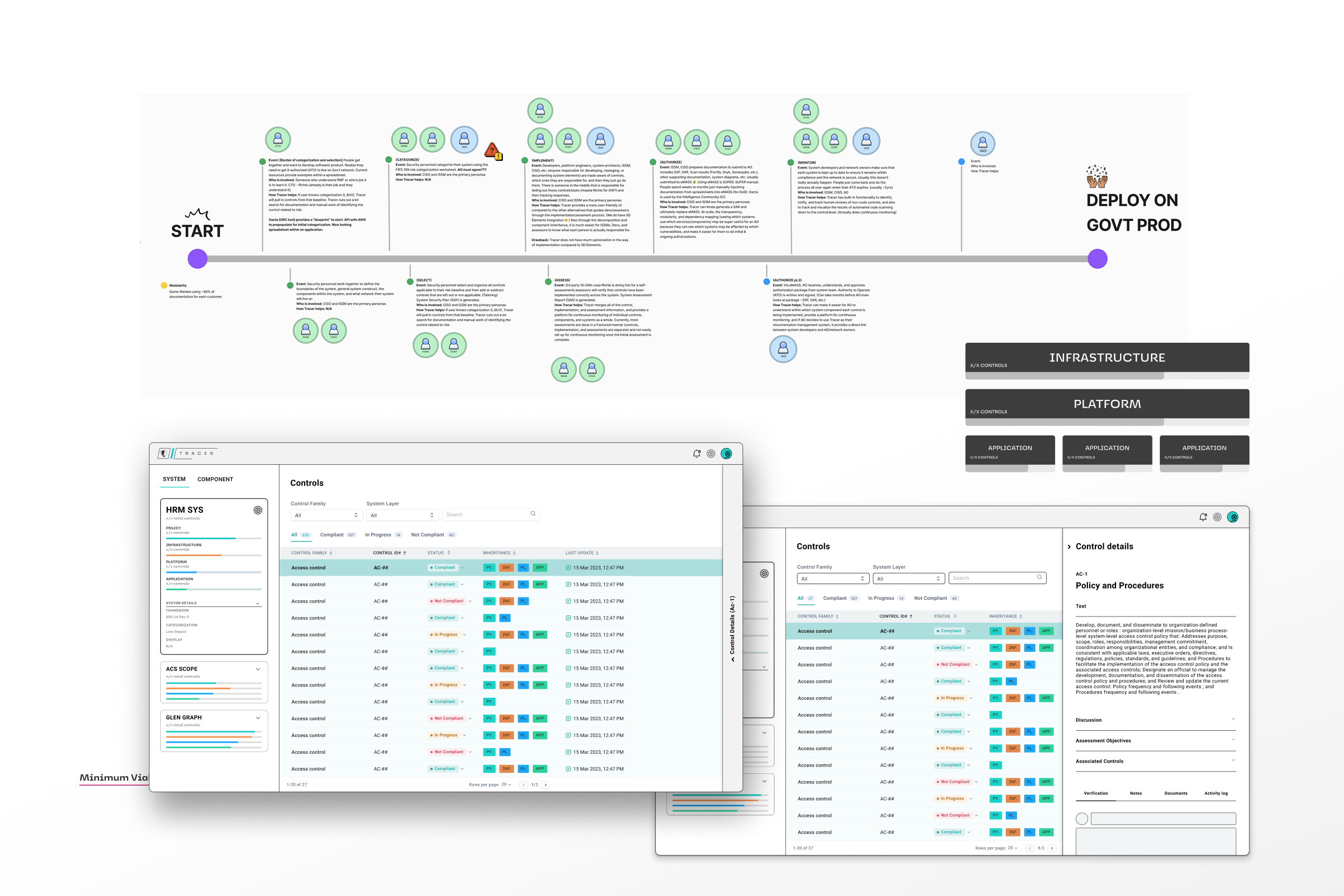
Rise8 identified a critical barrier threatening national security: the traditional Authority to Operate (ATO) process took 12-18 months and cost over $2 million per software deployment, delaying essential technology to warfighters. When I joined the Tracer team as an agency partner in early 2024, the challenge was clear that companies deploying software to government needed to easily view the complex compliance layers and component relationships, but existing tools buried this information in fragmented spreadsheets and opaque documentation.
Over six months, I led both product design and brand development for Tracer, working with a lean team to create an innovative component monitoring system design. My work focused on transforming inherently complex compliance workflows into an intuitive digital platform that supported the DoD's strategic shift from traditional ATO to continuous ATO (cATO) while building a brand that could stand out in the market while blending into the Rise8 family.
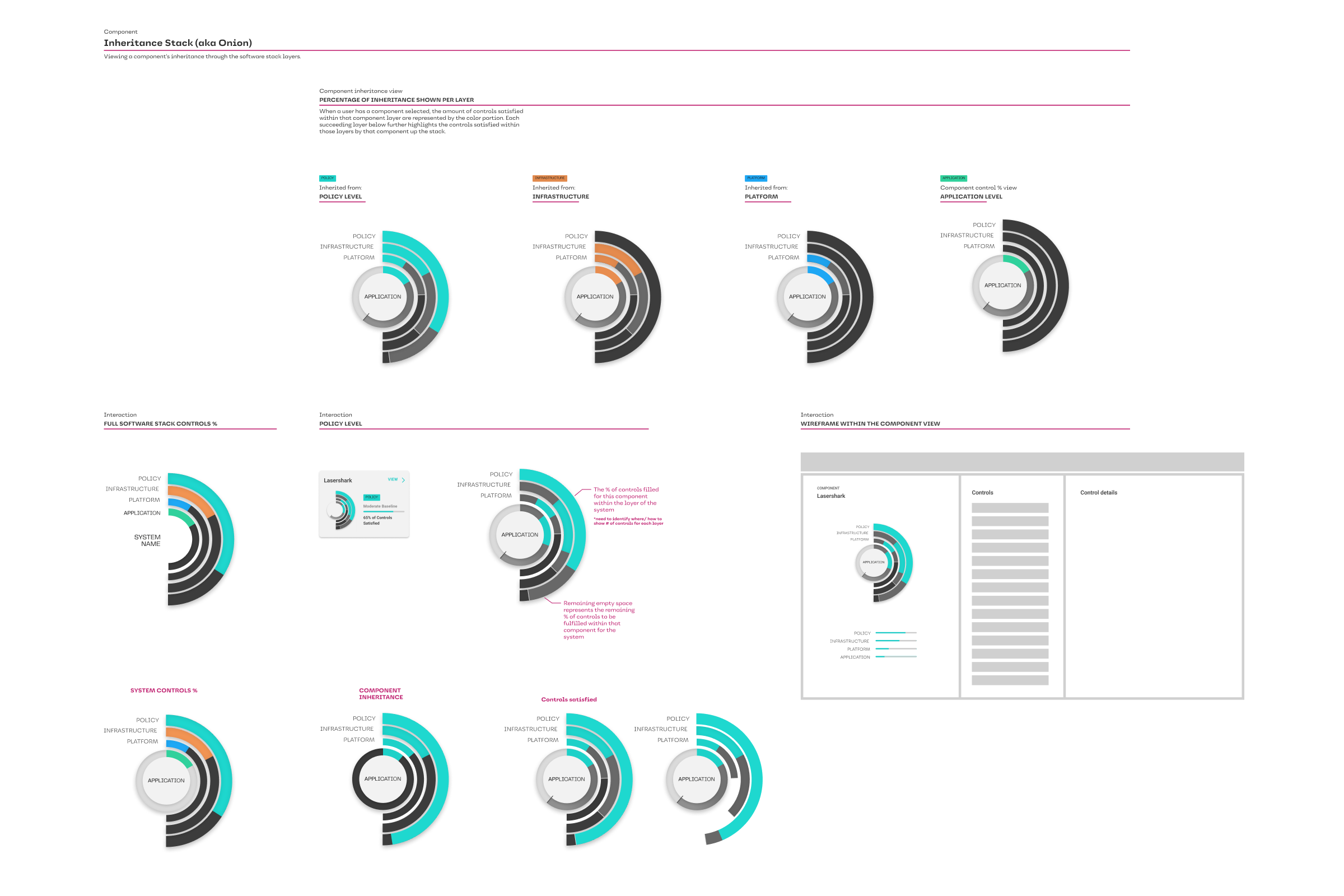
The design experience centered on more dedicated space for the various user roles and the interconnected tasks shared across them. We developed a visual system to represent compliance depth and relationship of controls with tree-type visual structure of the inheritance stack. It solved the problem of undersatdning the status of compliance structure and controls: how to make deeply interconnected, technically sophisticated information scannable and navigable for diverse stakeholders.
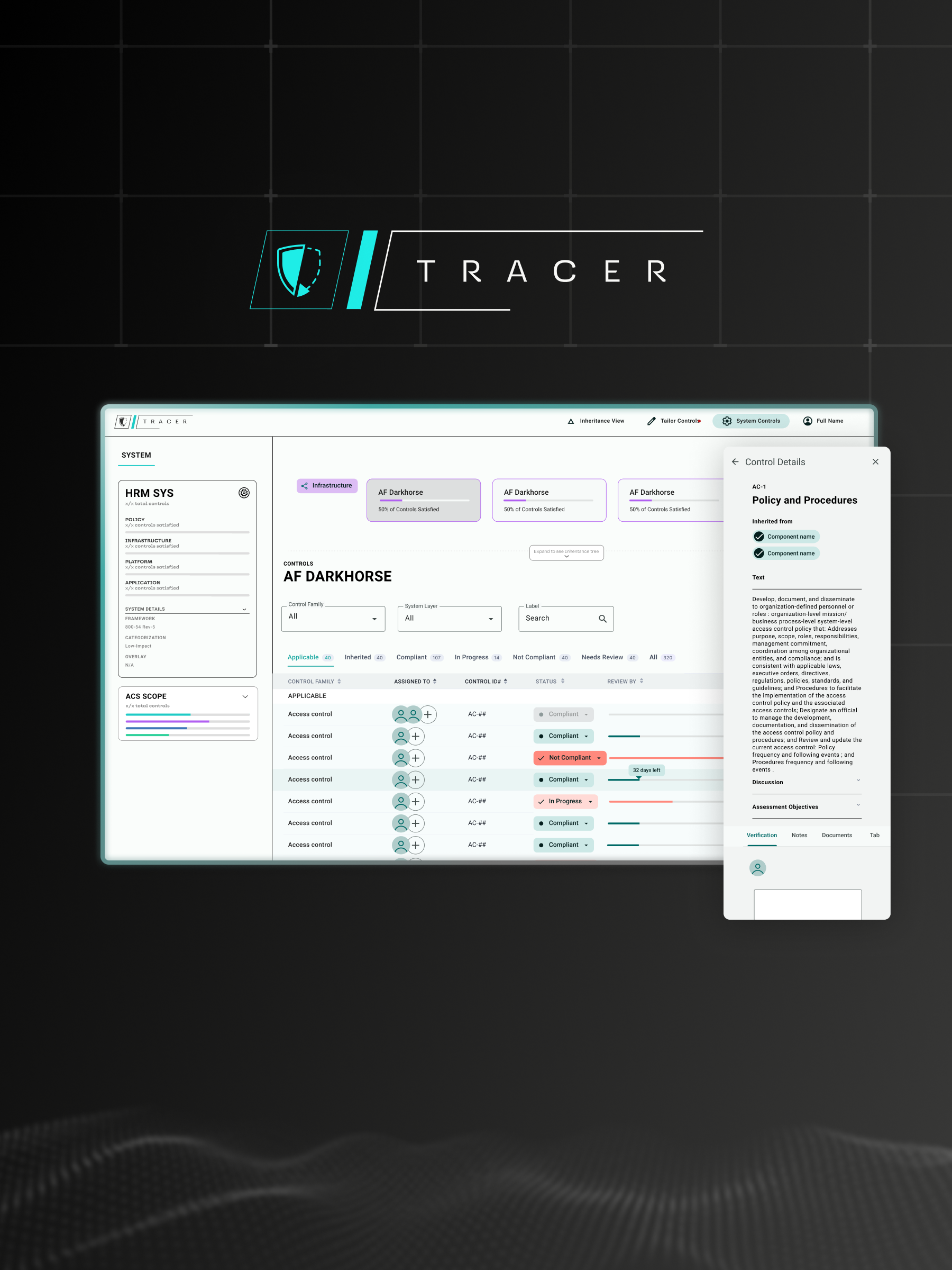
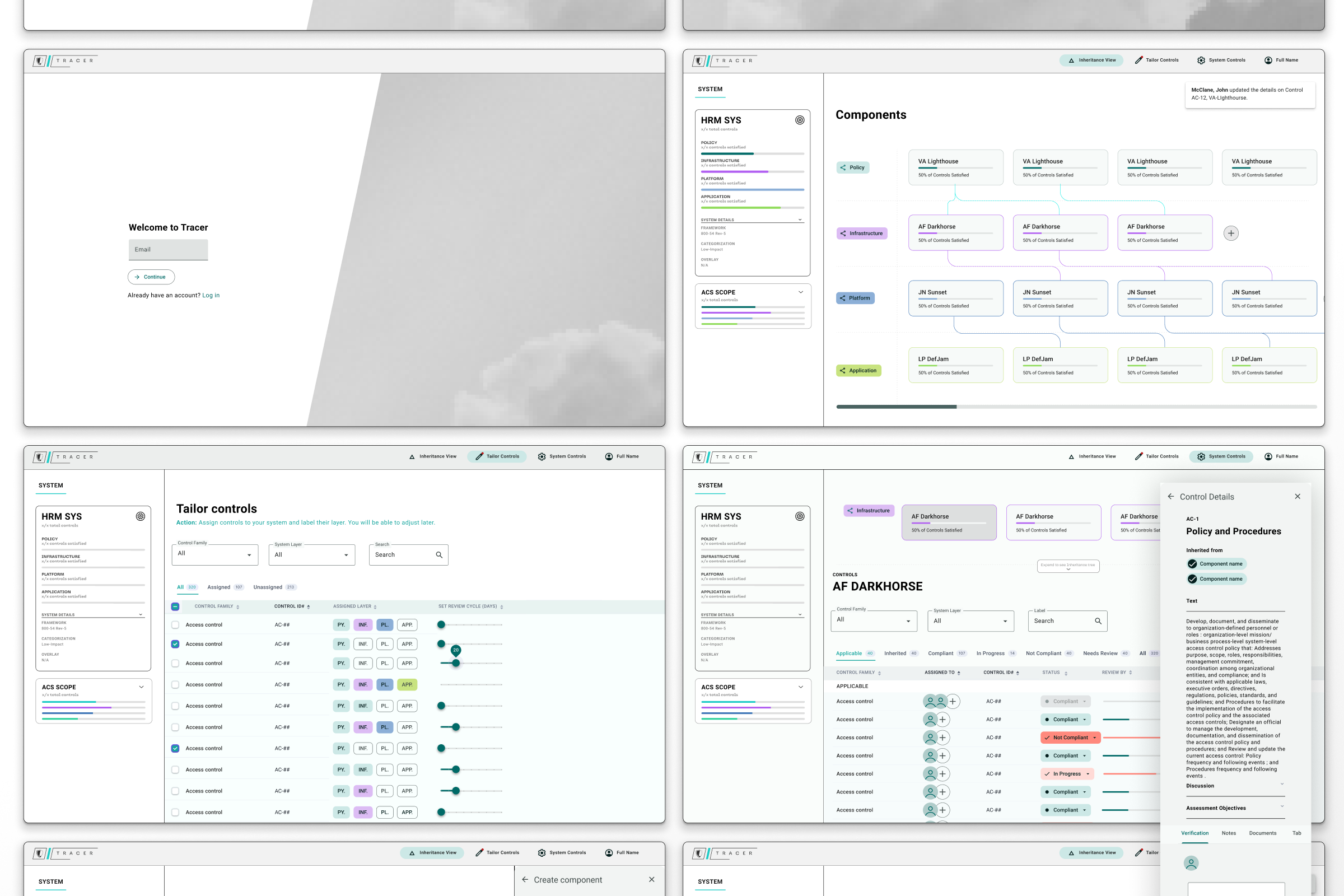
I led design of the product experience, structuring the interface around three role-based workflows: an Inheritance Stack showing system-level component relationships, a Tailoring Controls view for configuring requirements, and a System Controls tab for defining and verifying controls. Each tab allowed workspace focus appropriate to the individual's role while maintaining connections across the broader system architecture.
The System Controls and Tailoring Controls views became the platform's most sophisticated interfaces. I synthesized foreign government compliance vocabulary and variables into organizable tables that clearly showed: every relevant component detail, ownership (similar to project management tools), which NIST controls were being satisfied, and how everything connected across inheritance layers. The challenge was taking the data and making the inherent complexity of government compliance comprehensible without oversimplification. We needed to show what mattered to the user, with the right amount of control.
Through our research we recognized that compliance controls have significant layering and depth across inheritance stacks, while simultaneously having individual details for satisfying depending on the individual's touchpoint. This insight shaped every interface decision: how drawers expand to reveal detail, how tables organize multi-dimensional relationships, how visual hierarchy guides users through complexity.
Recognizing that our team's unfamiliarity with government compliance and its vocabulary could be a design liability, I advocated for collaboration with a partner of our content team, Dr. Dawn Blizzard, a PhD researcher well-versed in cybersecurity. Together we produced a research report documenting the evolution from ATO to cATO. This deep dive into domain knowledge informed every design decision and later became a crucial asset for our go-to-market strategy.
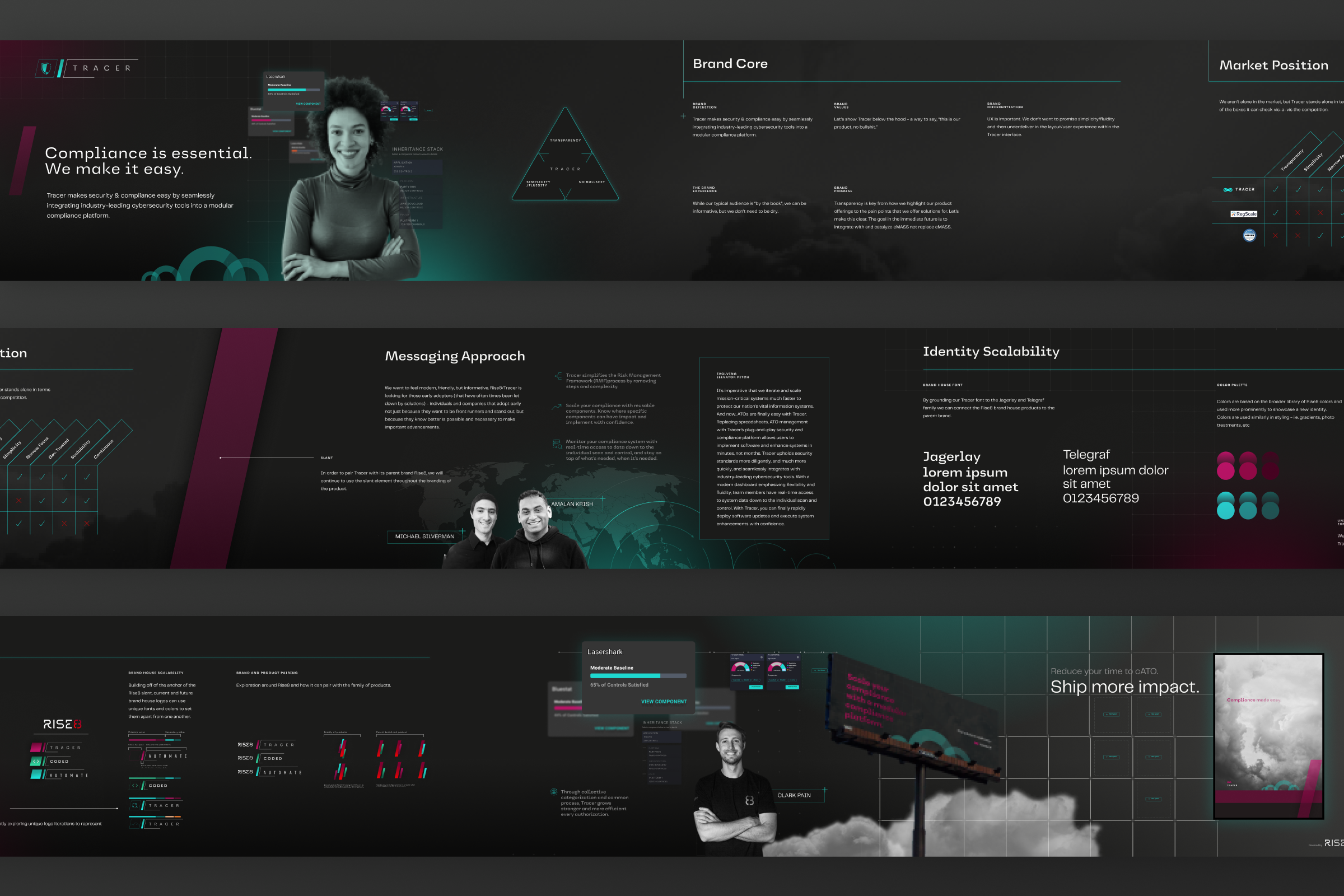
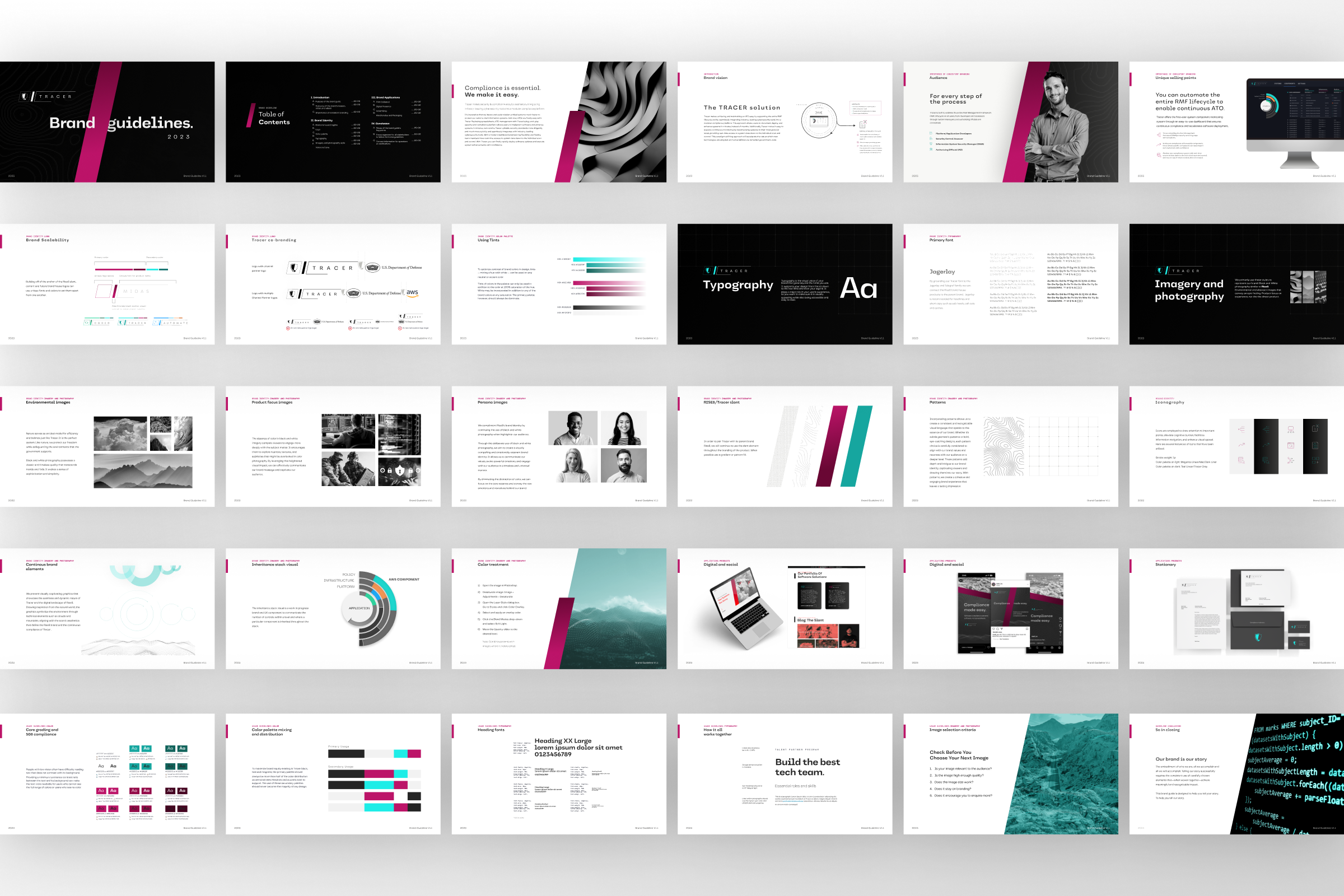
Beyond product design, I led the creation of Tracer's complete brand identity. We developed logo concepts, a visual system that enabled scale for future products within the Rise8 brand, business collateral, website design and branded materials that positioned the platform as the modern solution to government compliance challenges. The brand needed to communicate both technical sophistication and trustworthiness to conservative government stakeholders while feeling approachable enough to encourage adoption.
The product and brand work directly contributed to securing a $1.1 million SBIR (Small Business Innovation Research) grant, validating both the market need and our design approach. By creating a singular source of truth where developers, assessors, system managers, and authorizing officials could view information organized by their role's needs, Tracer addressed what DoD leadership identified as missing: "an ecosystem and support structure that allows you to see in real-time, understand the system, and get insight into changes."
Tracer represents an infrastructure for national security, enabling critical software to reach warfighters faster while maintaining rigorous security standards through design that makes complexity navigable.


